Overview
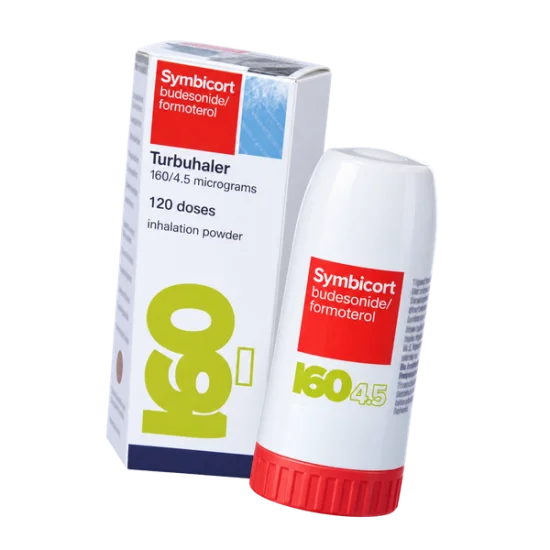
Symbicort 160/4.5 Turbuhaler contains budesonide, an inhaled corticosteroid, and formoterol, a long-acting beta2-agonist. The device provides inhaled powder in 120 doses. Together, the active ingredients address two processes that narrow the airways: persistent inflammation and contraction of bronchial muscle.
Pharmacological classification of active ingredients
The two components have different pharmacological roles:
- Budesonide: an inhaled corticosteroid that suppresses airway inflammation.
- Formoterol: a long-acting beta2-agonist that relaxes bronchial smooth muscle.
- Combination therapy: anti-inflammatory control plus sustained bronchodilation in one inhaler.
Therapeutic indications
Symbicort may be prescribed for asthma or chronic obstructive pulmonary disease (COPD), with the treatment plan depending on diagnosis, age, symptoms, lung function, previous exacerbations, and other medicines. The European Medicines Agency describes budesonide/formoterol combinations as therapies that can provide inhaled corticosteroid treatment alongside long-acting bronchodilation [1].
Targeted respiratory conditions
Asthma involves variable airway narrowing, inflammation, and increased sensitivity to triggers such as allergens, exercise, cold air, infections, or smoke. COPD involves persistent airflow limitation, often with chronic cough, sputum production, and breathlessness.
For moderate-to-severe asthma, Symbicort can form part of regular maintenance treatment. In selected asthma plans, the same budesonide/formoterol inhaler may be prescribed for both regular control and symptom relief. This approach is called maintenance-and-reliever therapy, or MART.
Treatment goals differ in COPD. Regular inhaled corticosteroid and long-acting bronchodilator therapy may reduce symptoms and exacerbations in selected patients, while the suitability of an inhaled corticosteroid depends on the individual clinical picture. Symbicort does not remove the need for a personalised COPD treatment plan.
Directions for use
The dose is decided individually, taking age, other medicines and health conditions into account. The prescribed schedule may differ between asthma maintenance, MART treatment, and COPD management.
Symbicort is inhaled through the mouth using the Turbuhaler device. The powder is released when the user loads a dose and breathes in firmly and deeply through the mouthpiece. It is not swallowed, mixed with water, or administered through the nose.
Practical administration principles
- Use the number of inhalations prescribed for your condition.
- Take regular doses at the times selected in the treatment plan.
- Use the inhaler only through the mouthpiece.
- Breathe in firmly enough to draw the dry powder into the lungs.
- Do not shake the device in the same way as a pressurised aerosol inhaler.
- Keep the mouthpiece clean and dry.
- If a dose is missed, take it when remembered unless the next dose is near; do not double the next inhalation.
The inhaler may deliver powder without a strong taste or visible sensation. A lack of taste does not mean that the dose failed. Loading the device more than once before one inhalation can also lead to an unintended extra dose.
A useful technique check is to practise the inhalation while sitting upright, then ask a respiratory nurse, doctor, or pharmacist to assess the technique during a clinical appointment. Dry-powder inhalers depend on inspiratory flow rather than hand-and-breath coordination.
When not to use it
Symbicort is not for you if you have had a serious allergy to its ingredients or need emergency treatment for acute breathing difficulty. The treatment plan may need adjustment or another option may be chosen in the following situations:
- Previous serious allergy to budesonide, formoterol, or an inhaler excipient.
- Severe acute asthma or COPD symptoms requiring emergency treatment.
- Significant heart rhythm disorders or uncontrolled cardiovascular disease.
- Untreated low potassium.
- Uncontrolled diabetes.
- Untreated pulmonary tuberculosis or other serious respiratory infection.
- Severe liver impairment.
- Previous paradoxical bronchospasm after inhaled treatment.
Interactions can occur with beta-blockers, including some eye drops, because they may reduce bronchodilator action or provoke bronchospasm. Diuretics, corticosteroids, and medicines that affect heart rhythm can increase the risk of low potassium or cardiac effects. Strong CYP3A4 inhibitors may raise budesonide exposure.
Tell the prescriber about medicines for heart disease, high blood pressure, depression, fungal infections, HIV, epilepsy, and thyroid disorders. This includes non-prescription medicines and inhaled treatments.
When this is not for you
This treatment may not be suitable if you have had a serious allergy to budesonide, formoterol, or an inhaler excipient. It may also be unsuitable if you have severe acute breathing problems, serious heart rhythm problems, untreated low potassium, uncontrolled diabetes, a serious respiratory infection, severe liver problems, or breathing that became worse after an inhaled treatment. If you use a beta-blocker for glaucoma or heart disease, mention the eye drops or tablets by name before starting treatment.
Unwanted effects
Symbicort can cause local effects from inhaled corticosteroid exposure and systemic effects from beta2 stimulation. Many reactions are mild, but persistent or severe symptoms require prompt clinical assessment.
Common or recognised effects may include:
- Hoarse voice or throat irritation.
- Oral candidiasis, also called oral thrush.
- Headache.
- Tremor or a feeling of shakiness.
- Palpitations or a faster heartbeat.
- Muscle cramps.
- Nausea.
- Sleep disturbance or nervousness.
Rinsing the mouth after use helps reduce local steroid effects. A spacer does not apply to the Turbuhaler in the same way it applies to a pressurised metered-dose inhaler, so mouth rinsing and technique review are more relevant practical measures for this device.
Rare but serious reactions include paradoxical bronchospasm, severe allergic reaction, significant heart rhythm disturbance, marked potassium reduction, and adrenal effects after prolonged high-dose corticosteroid exposure. Paradoxical bronchospasm means that breathing becomes worse immediately after inhalation. The inhaler should be stopped and urgent medical help obtained if this occurs.
One practical detail is easy to miss: formoterol can cause tremor or palpitations, especially after extra inhalations. Another is that repeated oral thrush may reflect both corticosteroid exposure and inhaler technique problems. The latter can be addressed during a structured inhaler review.
Common mistakes
Several avoidable habits reduce the benefit of inhaled treatment:
- Inhaling too gently for a dry-powder device.
- Exhaling into the mouthpiece, which introduces moisture.
- Loading a dose and then waiting too long before inhaling.
- Taking repeated extra doses because the powder has no strong taste.
- Stopping regular treatment as soon as symptoms improve.
- Skipping mouth rinsing after inhalation.
- Treating every episode of breathlessness with Symbicort without knowing whether the prescribed plan is maintenance-only or MART.
- Assuming a separate salbutamol inhaler and Symbicort can be used interchangeably.
- Leaving the device in a humid bathroom.
- Failing to mention frequent night symptoms at follow-up.
One common error is inhaling through the nose rather than the mouth. The medication is intended to travel through the mouthpiece into the lower airways, so nasal breathing does not deliver the intended dose.
Another is trying to wash the inhaler. Moisture can affect the powder and the internal mechanism. Cleaning should follow the device’s established handling instructions rather than exposing it to water.
Comparison
Comparison of Symbicort Delivery Devices
Symbicort Turbuhaler is a breath-actuated dry-powder inhaler. It differs from a pressurised metered-dose inhaler, which releases an aerosol when the canister is pressed. The active ingredients and prescribed dose must remain consistent with the specific device supplied.
| Device type |
Practical feature |
Technique focus |
| Symbicort Turbuhaler |
Breath-actuated dry powder |
Firm, deep inhalation through the mouthpiece |
| Pressurised metered-dose inhaler |
Aerosol released by canister actuation |
Press-and-breathe coordination; a spacer may help |
| Dry-powder inhaler category |
Powder dispersed by the patient’s inhalation |
Adequate inspiratory effort and a dry device |
Pressurised metered-dose inhaler formulations
A pressurised metered-dose inhaler releases a measured aerosol plume. The user must coordinate canister activation with a slow inhalation. A spacer can reduce coordination demands and improve delivery to the lungs, especially for people who struggle to synchronise pressing and breathing.
A spacer is not automatically interchangeable with a Turbuhaler. The two devices use different delivery principles, so the technique and instructions for one should not be transferred to the other.
Symbicort and Fast-Onset Bronchodilation Versus Short-Acting Rescue Inhalers
Formoterol is a long-acting beta2-agonist with a relatively rapid onset. Albuterol, also called salbutamol, is a short-acting beta2-agonist used in many treatment plans for rapid relief of bronchospasm.
Both medicines relax bronchial muscle, yet their treatment roles differ:
- Formoterol: long-acting bronchodilation, with rapid onset suitable for selected maintenance-and-reliever plans.
- Albuterol or salbutamol: short-acting bronchodilation, commonly used as a separate reliever.
- Budesonide/formoterol MART: combines anti-inflammatory treatment with reliever use when specifically prescribed.
A LABA should not be used as the only asthma treatment because bronchodilation does not control the underlying airway inflammation. Symbicort includes an inhaled corticosteroid for this reason.
A short-acting reliever does not replace regular anti-inflammatory treatment. Needing a reliever more frequently than planned can indicate deteriorating control, incorrect inhaler technique, an infection, or another trigger.
Keep the emergency plan written in the same terms as the prescription. Do not alternate between a separate reliever and Symbicort for symptom relief unless the treating clinician has explained which plan applies.
What doctors say
In respiratory practice, clinicians usually judge Symbicort by three factors: symptom control, exacerbation frequency, and inhaler technique. A patient may report taking every dose while still receiving little medicine in the lungs if the inhalation is too shallow or the device is loaded incorrectly.
A doctor also distinguishes poor control from poor adherence. Night waking, frequent wheeze, reduced activity, or repeated rescue inhaler use may point to uncontrolled disease. The response may involve technique correction, trigger management, treatment adjustment, or investigation for infection and other causes of breathlessness.
Doctors often advise patients to keep the regular plan separate from the emergency plan. Symbicort may be prescribed as maintenance and reliever therapy for some people, while others receive it only as maintenance alongside a separate short-acting reliever. These plans should not be mixed without explicit instructions.
The inhaled corticosteroid component needs regular use to control airway inflammation. Formoterol may make breathing feel easier quickly, yet symptom improvement does not prove that inflammation has resolved.