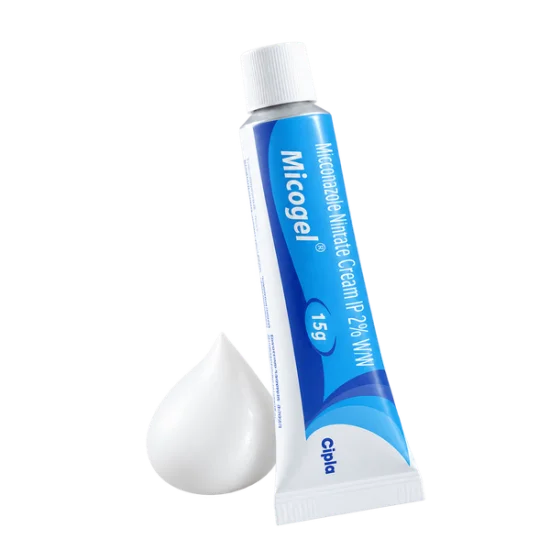
I used Micogel on a flaky itchy patch near my ankle after swimming. The itch eased after several applications, though the dry skin took longer to look normal. I was more careful about drying the area after showers.
10 Oct 2026
Micogel
Micogel is used where fungi or Candida affect the outer layers of skin. It helps stop fungal growth and ease associated itch, scaling, and irritation. Its active ingredient is miconazole nitrate, an…
Micogel is used where fungi or Candida affect the outer layers of skin. It helps stop fungal growth and ease associated itch, scaling, and irritation. Its active ingredient is miconazole nitrate, an imidazole antifungal.
Overview
Miconazole nitrate, the active ingredient of Micogel, is an imidazole antifungal gel for superficial fungal and yeast-related skin infections. It is used where fungi or Candida affect the outer layers of skin, helping stop fungal growth and ease associated itch, scaling, and irritation. Micogel contains miconazole nitrate 2% w/w.
Formulation
Micogel contains miconazole nitrate 2% w/w. Miconazole belongs to the imidazole class of antifungal medicines, a group that also includes clotrimazole and econazole.
Therapeutic indications
Micogel is intended for local treatment of superficial skin infections caused by susceptible fungi and yeasts. These infections often affect warm, moist skin folds, the feet, groin, trunk, or other areas where sweat and friction allow fungi to multiply.
Miconazole is active against dermatophytes, the fungi linked with athlete’s foot, ringworm, and jock itch. It also has activity against Candida species that can cause itchy, red, sore skin in folds or areas exposed to persistent moisture. HPRA product information for miconazole nitrate topical preparations describes its role in treating superficial fungal and yeast infections of the skin. [1]
Fungal and yeast infection spectrum
Topical miconazole is commonly used for:
- Athlete’s foot, also called tinea pedis
- Ringworm of the body, or tinea corporis
- Jock itch, or tinea cruris
- Yeast-related skin-fold irritation caused by Candida
- Pityriasis versicolor, where a clinician has identified a susceptible fungal cause
- Fungal rash with scaling, edge redness, or itch
A fungal infection can look different on different skin tones. It may show as scaling, cracking, colour change, a sharply defined edge, or persistent itch rather than obvious redness.
Micogel treats fungal growth on the skin. It does not treat eczema, psoriasis, bacterial cellulitis, viral cold sores, or allergic contact dermatitis unless a fungal infection is also present and has been identified.

Directions for use
Apply Micogel to clean, dry affected skin as a thin, even film. How much to use and how often depends on the purpose of use and is agreed with a doctor or pharmacist.
- Wash hands before and after use.
- Gently clean the affected skin and dry it fully.
- Apply a thin layer to the rash and a small margin of nearby skin.
- Leave the area uncovered unless a clinician has advised a dressing.
- Continue for the agreed treatment period, even if itch improves before the skin has settled.
Do not share towels, socks, footwear, razors, or washcloths while treating a contagious fungal infection. Reinfection often comes from damp footwear, shared textiles, or stopping treatment as soon as visible redness fades.
Micogel should not be used more frequently simply because the rash is uncomfortable. More frequent application raises irritation risk without proving a faster cure.
When not to use it
Avoid applying the gel to the eyes, inside the mouth, or other mucous membranes unless a clinician has specifically directed its use there. Do not apply it to a deeply broken wound, a large burn, or skin with signs of bacterial infection such as increasing pain, pus, heat, or fever.
Use needs extra care in these situations:
- A rash of uncertain cause
- Extensive skin involvement
- Recurrent fungal infections without a clear trigger
- Diabetes with foot skin changes or reduced sensation
- A weakened immune system
- Use of warfarin or another vitamin K antagonist
Topical miconazole can rarely interact with warfarin, especially when used extensively or on damaged skin. A person using warfarin who develops unusual bruising, bleeding gums, black stools, or nosebleeds needs urgent medical review.
Pregnancy and breastfeeding require individual assessment because the choice of topical treatment depends on the affected area, amount used, and clinical need. Do not apply Micogel to the breast immediately before breastfeeding.
When this is not for you
Micogel is not for you if you have had an allergic reaction to miconazole, other imidazole antifungals, or any component of the gel.
Unwanted effects
Most people tolerate topical miconazole well when it is applied to intact external skin in a thin layer. Local reactions can still occur, and they deserve attention because an irritated rash is not always a fungal rash.
Possible effects include:
- Mild burning or stinging after application
- Itching or local irritation
- Redness, dryness, or peeling
- Contact dermatitis or an allergic skin reaction
- Swelling, hives, blistering, or worsening discomfort in rare cases
A brief warm or tingling feeling can occur on broken skin. It should not intensify with repeated use.
Topical miconazole has low absorption through intact skin, so whole-body adverse effects are unusual. Risk may rise when it is used on large damaged areas, under an occlusive dressing, or for prolonged periods without reassessment. FDA drug-label information for topical miconazole lists local irritation and hypersensitivity among relevant adverse reactions. [2]
Stop using Micogel and seek prompt medical assessment if there is facial swelling, breathing difficulty, widespread hives, marked blistering, or rapidly spreading redness. These symptoms may indicate a significant allergic reaction or a different skin condition requiring another treatment.
How it affects the body
Fungal cells need ergosterol to maintain a stable cell membrane. Miconazole blocks an enzyme involved in ergosterol production, making the fungal membrane less functional and limiting fungal growth. Human skin cells do not use ergosterol, which explains why this mechanism targets fungi rather than normal skin tissue.
Miconazole does more than reduce visible redness. It acts on the cause when the rash is due to a susceptible fungus or yeast.
Common mistakes
- Stopping when itch improves: symptoms may settle before fungal growth is fully controlled.
- Applying gel to wet skin: water dilutes the product and maintains the moist environment fungi prefer.
- Treating only the centre of the rash: active fungus may extend beyond the most visible edge.
- Using a steroid cream alone: redness may fade while the fungal infection continues to expand.
- Ignoring footwear and laundry: socks, shoes, towels, and sports gear can contribute to recurrence.
- Treating a changing rash for too long: a rash that spreads, becomes painful, or develops pus needs reassessment rather than repeated application.
A ring-shaped border is a useful clue, not a diagnosis by itself. Skin conditions can imitate one another closely.
Comparison
Miconazole is one of several topical imidazole antifungals used for superficial dermatophyte and yeast infections. Clotrimazole is another common imidazole option for conditions such as tinea cruris, tinea corporis, and athlete’s foot.
| Active ingredient | Drug class | Practical distinction |
|---|---|---|
| Miconazole | Imidazole antifungal | The active ingredient in Micogel; used for susceptible fungal and yeast skin infections |
| Clotrimazole | Imidazole antifungal | Similar antifungal category, used for many superficial dermatophyte and Candida infections |
| Terbinafine | Allylamine antifungal | Often used for dermatophyte infections; its mechanism differs from imidazoles |
Choice depends on the suspected organism, body site, degree of inflammation, previous treatment response, and whether the rash is truly fungal. Terbinafine can be useful for dermatophyte infections, while imidazoles such as miconazole and clotrimazole provide broad topical coverage for common fungal and yeast-related rashes.
A Cochrane review found that topical antifungals are more effective than placebo for tinea corporis and tinea cruris, though studies did not establish one topical option as best for every person or every site. [4]
What doctors say
In clinical practice, doctors often separate three questions: does the rash look fungal, is the infection limited to the skin, and is there a reason it keeps returning? That approach prevents months of treating eczema, psoriasis, or bacterial folliculitis with an antifungal that cannot address the real cause.
A clinician will often expect early easing of itch before the skin fully recovers. Scaling and colour change can take longer to settle because skin renewal is gradual. Fungal infections involving nails, scalp, or widespread body areas may need a different plan because topical gel may not reach the infection adequately.
WHO’s 2022 fungal priority pathogens work highlights the broader clinical burden of fungal disease, while routine superficial skin infections still require diagnosis based on the site, appearance, and response to treatment. [3]
Common questions
Can Micogel be used under 18?
Use in children and adolescents should be based on clinical advice because the right treatment depends on the rash location, cause, and extent. Younger children can develop irritant or inflammatory rashes that resemble fungal infection. HPRA information from 2024 on topical miconazole supports its local antifungal role, but a persistent or widespread rash in a child needs assessment before continued treatment. Avoid using it near the eyes or on large areas of damaged skin. A pharmacist can help confirm whether self-treatment is suitable.
Can sun exposure affect Micogel treatment?
Miconazole is not generally known as a major photosensitising antifungal. Sun and heat can still aggravate inflamed skin, increase sweating, and make skin-fold fungal problems more uncomfortable. EMA topical-product guidance from 2019 supports applying locally acting medicines to clean, dry skin and avoiding practices that undermine skin-barrier recovery. Covering a rash with breathable clothing may be more comfortable than heavy occlusion in hot weather.
How long does one Micogel application keep working?
Miconazole remains on the treated skin after application, yet washing, sweating, rubbing clothing, and swimming can remove part of the gel film. The intended application schedule should be agreed with a doctor or pharmacist rather than adjusted according to how quickly itch returns. FDA topical miconazole information from 2023 describes local application as the route for treating superficial infection. Reapplying immediately after every minor sensation is not useful and may irritate the skin.
What should I do after a missed Micogel application?
Apply the next planned application when remembered, unless it is close to the next agreed time. Do not use a double amount to compensate for the missed application. This keeps irritation risk lower while preserving a consistent treatment pattern. The WHO’s 2022 work on fungal disease reinforces that persistent infection needs a clear treatment plan rather than irregular bursts of treatment.
What should I do if the expected result does not come?
A rash that is not improving, is spreading, becomes painful, produces pus, or repeatedly returns should be reassessed. The cause may be a non-fungal skin disorder, a bacterial infection, a resistant organism, or an infection needing a different route of treatment. Cochrane evidence from 2014 supports topical antifungals for tinea corporis and tinea cruris, yet it does not mean every itchy rash is tinea. Nail and scalp infections also often need a different approach from a topical skin gel.
Can older adults use Micogel?
Older adults can use topical miconazole when it is appropriate for the diagnosed skin condition. Extra care is sensible where skin is thin, fragile, cracked, poorly perfused, or affected by diabetes, as these factors can alter both infection risk and skin tolerance. HPRA product information from 2024 for miconazole nitrate topical preparations supports local treatment of susceptible superficial infection. A new foot rash with numbness, ulceration, marked swelling, or delayed healing needs prompt clinical assessment.
Do you offer anonymous delivery?
Your order will be securely packed and shipped within 24 hours. This is exactly what your package will look like (images of an actual item sent). It has the size and look of a regular private letter (24x11x0.7 cm) and its contents cannot be seen.
Comparison
Sources
- HPRA (2024). Summary of Product Characteristics (SmPC) — Miconazole nitrate 2% topical preparations.
- FDA (2023). Miconazole nitrate topical antifungal — Drug Facts label.
- WHO (2022). WHO fungal priority pathogens list to guide research, development and public health action.
- Cochrane (2014). Topical antifungal treatments for tinea cruris and tinea corporis.
How Buyers Rate Micogel
Based on 3 reviews
I used it for redness and irritation in a skin fold during a warm spell. It felt slightly stingy on the first day because the skin was sore, then that passed. Keeping the area dry made more difference than I expected.
27 Oct 2026I expected the rash to clear in a day or two, so I was frustrated at first. After the patch spread instead of settling, I had it assessed and it turned out not to be a straightforward fungal rash. The gel was easy to apply, but it was not the right answer for that skin problem.
7 Nov 2026