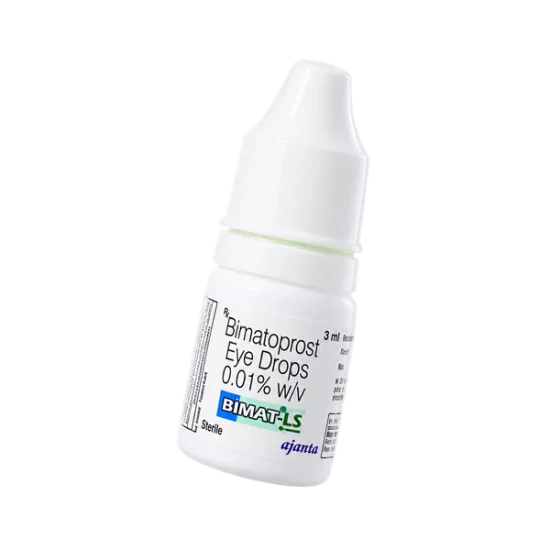
Formulation
Bimat contains bimatoprost 0.01% w/v in a sterile ophthalmic solution supplied in a bottle. Bimatoprost belongs to the prostaglandin analogue class and is used in eye care to reduce elevated intraocular pressure. The product is intended for application to the eye, not for oral use or application to the skin.
Raised intraocular pressure can damage the optic nerve gradually. Glaucoma may progress without pain or obvious early symptoms, so treatment aims to control pressure before further optic-nerve injury occurs. Bimatoprost is listed in regulatory ophthalmic information as a pressure-lowering treatment for conditions such as open-angle glaucoma and ocular hypertension [1].
Active ingredient and pharmacological class
Bimatoprost is a synthetic prostamide-related compound with effects on aqueous-humour drainage. Aqueous humour is the clear fluid produced inside the eye. When its production and drainage are unbalanced, intraocular pressure can rise.
The regimen for this chosen strength should be confirmed with a healthcare professional before starting.
The product is supplied as drops in a 3 ml bottle.
Keep the bottle tip away from the eyelashes, eyelids and fingers during application. Contact with these surfaces can transfer microorganisms into the solution.
Bimatoprost may also affect eyelash follicles by prolonging the active growth phase of lashes. Published eyelash studies mainly evaluated specific cosmetic formulations and concentrations, so use for eyelash hypotrichosis requires a clinician-confirmed regimen rather than assuming that an eye-pressure dose is interchangeable with a lash-growth protocol.
Therapeutic indications
In glaucoma or ocular hypertension, the treatment goal is a sustained reduction in intraocular pressure that helps protect the optic nerve. For eyelash hypotrichosis, research with bimatoprost-based treatment found progressive changes in lash length, darkness and fullness over several weeks.
NICE guidance recommends pressure monitoring as part of ongoing glaucoma management [2].
Directions for use
The regimen for Bimat should be confirmed with a healthcare professional before starting. The prescribed schedule depends on the condition being treated, the pressure target and whether another eye drop is already being used.
For ophthalmic use, the practical procedure is:
- Wash and dry the hands before application.
- Tilt the head back and gently pull the lower eyelid down.
- Place the prescribed number of drops into the affected eye without touching the eye with the bottle tip.
- Close the eye gently for a short period.
- Press lightly at the inner corner of the closed eye if the clinician has advised punctal occlusion.
- Wipe excess liquid from the cheek with a clean tissue.
- Replace the bottle closure promptly after use.
Bimat should be used at the same time each day when a once-daily schedule has been prescribed. Do not increase the frequency to speed up the response. More frequent use may reduce the pressure-lowering response and may increase local irritation.
When several eye medicines are prescribed, separate their applications by at least five minutes unless the prescribing clinician has provided another schedule. Eye ointments are generally applied after drops because an ointment layer can interfere with later drop penetration.
The bottle is for ophthalmic use only. It should not be swallowed, poured onto contact lenses or used by another person.
Remove contact lenses before applying Bimat if they contain preservatives or if the prescribing instructions require removal. Wait at least 15 minutes before replacing lenses unless a clinician has advised a different interval.
If a dose is forgotten, apply it when remembered unless the next scheduled dose is close. In that situation, skip the missed dose and continue at the normal time. Do not apply extra drops.
When this is not for you
Bimat is not for you if you have had an allergic reaction to bimatoprost or any ingredient in the drops. You should speak to a clinician before use if you have eye inflammation, corneal problems, macular oedema, previous herpes infection of the cornea, cataract-surgery complications, or are pregnant or breastfeeding. Do not add another pressure-lowering prostaglandin drop or stop glaucoma treatment without medical direction.
Unwanted effects
The most frequent reactions are local and affect the eye or surrounding skin. Reported effects with bimatoprost ophthalmic products include:
- Conjunctival redness or hyperaemia
- Itching or irritation
- Dry-eye symptoms
- Temporary blurred vision after application
- Increased tear production
- Darkening of the skin around the eye
- Eyelash growth or changes in lash direction
- A sensation of a foreign body in the eye
Redness may be more noticeable during the first weeks. It can improve with continued treatment, though persistent or troublesome redness requires clinical review.
Bimatoprost may gradually increase brown pigmentation of the iris. This change can be permanent, especially in eyes with mixed iris colours. The change may develop slowly and may not be obvious at first. The prescribing clinician should document the baseline appearance of the iris when appropriate.
Skin darkening around the eyelids may improve after stopping treatment, while iris pigmentation may remain. Eyelash changes may include longer lashes, uneven growth or lashes touching the eye surface.
Rare but urgent problems include marked eye pain, a sudden change in vision, pronounced light sensitivity, severe swelling or symptoms suggesting an allergic reaction. These symptoms require prompt medical attention.
Temporary blur immediately after an eye drop can make driving unsafe. Wait until vision has returned to normal before driving, cycling or operating machinery.
How it affects the body
Bimatoprost lowers intraocular pressure by increasing the outflow of aqueous humour through the uveoscleral route. This gives fluid an additional pathway to leave the eye, reducing pressure inside the eye over time.
Bimatoprost also interacts with biological pathways involved in the hair-growth cycle. Eyelash follicles move through anagen, the active growth phase; catagen, a transitional phase; and telogen, a resting phase. Bimatoprost may increase the proportion of lashes in anagen and may make lashes appear longer, darker or thicker. The supporting clinical evidence concerns dedicated eyelash-treatment regimens, including bimatoprost 0.03%, rather than automatically confirming the same cosmetic result from Bimat 0.01% [5]. Changes in lash appearance should be discussed before treatment is continued for cosmetic reasons.
Common mistakes
- Touching the bottle tip to the eye or eyelashes
- Applying two drops because one drop seemed to miss
- Using Bimat more frequently than prescribed
- Stopping when the eyes feel comfortable
- Applying several eye drops one immediately after another
- Continuing contact lenses during application when removal is required
- Rubbing the eyelids after the liquid has run onto the skin
- Sharing the bottle with another person
- Keeping the bottle in a hot car or freezing travel bag
- Adding another prostaglandin analogue without medical direction
One missed dose is usually managed by returning to the regular schedule. Repeated missed doses are different because they may compromise pressure control. A simple daily routine, such as applying the drop at the same evening hygiene step, can reduce forgotten applications.
If the drop lands on the cheek rather than in the eye, do not automatically repeat it. Avoiding double dosing is safer unless the prescribing instructions specifically address that situation.
Comparison
Bimatoprost, latanoprost and beta-blocker eye drops lower intraocular pressure through different pharmacological pathways. The choice depends on pressure control, eye history, heart and lung conditions, dosing preference and adverse effects.
| Treatment category |
Main pressure-lowering pathway |
Key clinical limitation |
| Bimatoprost |
Increases uveoscleral aqueous-humour outflow |
Redness, eyelid or iris pigmentation and lash changes may occur |
| Latanoprost |
Increases uveoscleral aqueous-humour outflow through prostaglandin-related activity |
Similar local effects can occur; response varies between patients |
| Beta-blocker eye drops |
Reduces aqueous-humour production |
May be unsuitable with asthma, slow heart rate or some cardiac conditions |
Bimatoprost and latanoprost are pharmacologically related, but they are not interchangeable without a prescribing decision. A person already using latanoprost should not add Bimat independently.
Beta-blocker drops can be useful for some patients but may have systemic effects after absorption through the tear duct. This is why a history of asthma, chronic obstructive pulmonary disease, bradycardia or heart block matters when selecting treatment.
The American Academy of Ophthalmology identifies prostaglandin-type therapy as an important option for primary open-angle glaucoma, while treatment remains individualised according to the target pressure and risk of progression [4].
What doctors say
In clinical practice, doctors usually judge Bimat by measured intraocular pressure, optic-nerve findings and visual-field results rather than by symptoms alone. A patient can feel well while glaucoma continues to progress, so regular reviews remain part of treatment.
A clinician also looks for technique-related problems before changing the medicine. A contaminated nozzle, drops landing on the eyelid instead of the eye, or inconsistent timing can make treatment appear less successful.
A 2023 review in glaucoma care supports individualised pressure targets and continued monitoring rather than relying on a single reading [3].