Used Combigan twice daily for several months after one drop did not control the pressure sufficiently. The first week brought mild stinging and temporary blur, but closing his eyes after application made the routine easier. He found the bottle simpler than using two separate drops.
Several months 23 Nov 2026
Combigan
People with glaucoma or ocular hypertension may need more than one pressure-lowering mechanism. Combigan combines brimonidine and timolol in ophthalmic drops for adults whose eye pressure remains too…
People with glaucoma or ocular hypertension may need more than one pressure-lowering mechanism. Combigan combines brimonidine and timolol in ophthalmic drops for adults whose eye pressure remains too high with one treatment. It lowers intraocular pressure and helps reduce the risk of further optic-nerve damage.
Overview
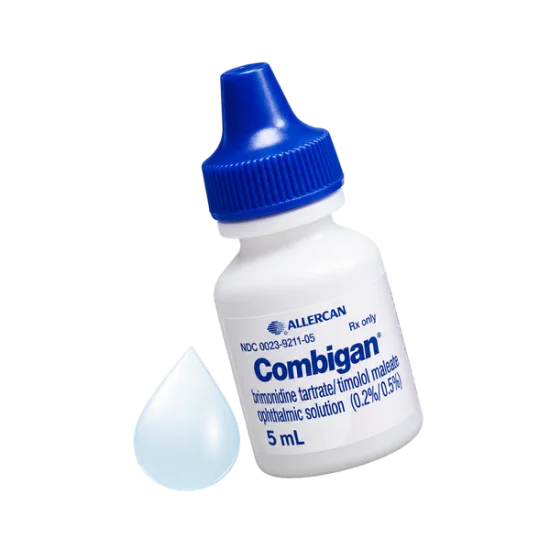
Combigan is a prescription ophthalmic antiglaucoma preparation used for glaucoma treatment and ocular hypertension therapy in adults. The bottle contains a 5 mL ophthalmic solution for application into the eye. Its role is to reduce elevated intraocular pressure, also called IOP.
Formulation
Combigan contains brimonidine tartrate 0.2% and timolol maleate 0.5% in an ophthalmic solution. These are two different active substances with complementary pressure-lowering actions.
Brimonidine belongs to the alpha-2 adrenergic receptor agonist group. Timolol belongs to the beta-blocker group.
| Active ingredient | Pharmacological class | Main action |
|---|---|---|
| Brimonidine tartrate 0.2% | Alpha-2 adrenergic receptor agonist | Reduces aqueous humour production and may improve its drainage |
| Timolol maleate 0.5% | Beta-blocker | Mainly reduces aqueous humour production |
Therapeutic indications
Combigan Eye Drops are used for:
- Open-angle glaucoma.
- Ocular hypertension.
- Pressure control when one ophthalmic medicine has not lowered IOP enough.
- Treatment plans requiring both an alpha-2 adrenergic agonist and a beta-blocker.
The Irish Health Products Regulatory Authority (HPRA) product information describes Combigan as a fixed combination of brimonidine and timolol for reducing raised intraocular pressure [1].
Directions for use
The prescribed dose takes priority because dosing differs between strengths, treatment plans and individual patients. Combigan is commonly administered as one drop in the affected eye or eyes twice daily, approximately 12 hours apart, when this is the regimen selected by the ophthalmologist.
Use the drops as follows:
- Wash and dry your hands.
- Remove contact lenses before application.
- Tilt the head back and look upwards.
- Gently pull down the lower eyelid to create a small pocket.
- Instil one prescribed drop without touching the eye, eyelid or eyelashes with the dropper tip.
- Close the eye gently rather than blinking repeatedly.
- Press the inner corner of the closed eye near the nose for about one minute.
- Replace the bottle closure promptly.
Contact lenses should be removed before use. Preservatives in ophthalmic preparations may irritate lenses and the ocular surface. Replace lenses only after the interval specified in the Combigan product information or by the eye-care professional managing your treatment.
When several ophthalmic preparations are prescribed, separate them by at least five minutes unless a different interval has been provided. Eye ointments are usually applied after drops because ointment can interfere with the absorption of a liquid preparation.
If a dose is missed, apply it when remembered unless the next scheduled dose is close. Skip the missed dose when necessary and continue with the regular timetable. Do not instil two drops to compensate.
The bottle should be kept according to the storage conditions stated in the product information, protected from unsuitable heat and contamination. During travel, carry it in a secure place where it will not be crushed or exposed to extreme temperatures.

When not to use it
- A known allergy to brimonidine, timolol or an excipient in the formulation.
- Bronchial asthma or a history of severe asthma.
- Severe chronic obstructive pulmonary disease with significant airway obstruction.
- Sinus bradycardia, meaning an unusually slow heart rate.
- Second- or third-degree heart block without a functioning pacemaker.
- Overt cardiac failure or certain serious rhythm disorders.
When this is not for you
This medication is not for you if you have:
- A known allergy to brimonidine, timolol or an excipient in the formulation.
- Bronchial asthma or a history of severe asthma.
- Severe chronic obstructive pulmonary disease with significant airway obstruction.
- Sinus bradycardia, meaning an unusually slow heart rate.
- Second- or third-degree heart block without a functioning pacemaker.
- Overt cardiac failure or certain serious rhythm disorders.
The EMA and FDA product information describes these reproductive and paediatric considerations [2].
Unwanted effects
Local eye effects are more common than serious systemic reactions. Possible effects include:
- Eye redness.
- Burning, stinging or irritation after application.
- Itching.
- Dry eyes.
- Watery eyes.
- Blurred vision immediately after instillation.
- Eyelid swelling or irritation.
- Foreign-body sensation.
- Allergic conjunctivitis.
- Conjunctival folliculosis, in which small follicles develop on the inner eyelid surface.
Blurred vision after a drop can be temporary. Driving or operating machinery should wait until vision has cleared fully.
Systemic effects can occur because timolol and brimonidine may pass through the tear ducts into the bloodstream. These may include dizziness, tiredness, headache, low blood pressure, slow pulse, cold hands or feet and worsening breathing symptoms.
Seek urgent medical attention for:
- New wheezing or marked shortness of breath.
- Fainting or severe weakness.
- A very slow or irregular heartbeat.
- Facial, lip, tongue or throat swelling.
- Widespread rash with breathing difficulty.
- Severe eye pain, sudden visual change or pronounced light sensitivity.
One practical detail is easy to miss: eye redness may come from irritation, allergy or the underlying disease, and its meaning cannot be judged from colour alone. Persistent redness, worsening pain or a sustained change in vision requires prompt clinical assessment.
How it affects the body
Brimonidine reduces the formation of aqueous humour and can increase uveoscleral outflow, which is one route by which fluid leaves the eye. Timolol reduces aqueous humour production by blocking beta-adrenergic stimulation in the ciliary body. Using both mechanisms can produce stronger pressure reduction than either substance alone for some patients.
Common mistakes
Common patient mistakes include:
| Mistake | Why it matters | Safer approach |
|---|---|---|
| Touching the dropper tip to the eye | Can contaminate the solution and irritate the eye | Keep the tip above the lower-eyelid pocket |
| Blinking repeatedly after application | Can pump the drop into the tear duct | Close the eye gently and use punctal occlusion |
| Doubling after a missed dose | May increase local and systemic exposure | Skip the missed dose if the next dose is near |
| Stopping when the eyes feel comfortable | Pressure can rise without noticeable symptoms | Continue the prescribed schedule |
| Using several drops back-to-back | The second drop may wash out the first | Separate ophthalmic preparations by about five minutes |
| Wearing contact lenses during application | Preservatives may irritate lenses and the ocular surface | Remove lenses first and replace them at the advised interval |
One small technique change often makes a difference: the lower-eyelid pocket should be created with a clean finger, while the other hand steadies the bottle. This is easier than trying to aim directly at the centre of the eye.
Do not stop Combigan because redness or pressure symptoms have improved. Pressure control is preventive, and glaucoma may continue to progress without pain or obvious visual change. Follow-up appointments allow the ophthalmologist to decide whether the regimen is controlling the disease.
Comparison
Combination glaucoma drops bring two active mechanisms into one bottle. This can reduce the number of bottles and administration times when both brimonidine and timolol are needed.
| Treatment approach | Main practical feature | Main limitation |
|---|---|---|
| Combigan | Brimonidine and timolol in one ophthalmic solution | Includes beta-blocker precautions and may cause local or systemic effects |
| Separate brimonidine plus timolol | Allows each medicine to be adjusted independently | Requires more bottles and more administration steps |
| Single-agent glaucoma drop | Simpler regimen with one active mechanism | May not lower pressure enough for every patient |
A generic brimonidine/timolol preparation may be clinically comparable when it contains the prescribed active ingredients, strengths and suitable formulation. Switching requires ophthalmic guidance because preservatives, dosing schedules and tolerability can differ.
Single-agent treatment may be preferable when one medicine already controls IOP, when the other component is contraindicated or when adverse effects make combination therapy unsuitable. Fixed-dose therapy may be more convenient for someone who struggles with several daily administration steps, but convenience does not outweigh a respiratory or cardiovascular contraindication.
The WHO describes glaucoma as a major cause of irreversible vision loss and identifies pressure reduction as the main modifiable treatment target [3].
What doctors say
In clinical practice, ophthalmologists assess Combigan by measuring intraocular pressure, examining the optic nerve and reviewing visual-field results. Symptoms alone are unreliable because glaucoma can progress while vision still feels normal.
A doctor also checks whether the drops are being used consistently and whether the bottle technique is reducing delivery. A pressure reading that remains high does not always mean the medicine has failed; missed doses, poor drop placement, blocked drainage or an incorrect timetable may contribute.
Common questions
Can people under 18 use Combigan?
Combigan is intended mainly for adults, and paediatric use requires specialist assessment. Brimonidine may cause pronounced drowsiness, low blood pressure or breathing problems in younger patients. The HPRA product information reviewed in 2024 sets out age-related restrictions and precautions for brimonidine/timolol ophthalmic treatment .
How should Combigan be stored at home and while travelling?
Store the bottle according to the storage conditions in the authorised product information and keep it protected from excessive heat, freezing and contamination. During travel, keep it secure and upright where possible rather than loose in a bag with sharp objects. The EMA product information from 2022 describes storage and handling requirements for ophthalmic preparations containing brimonidine and timolol .
Can alcohol be used while taking Combigan?
Alcohol may increase dizziness, light-headedness or tiredness in someone who already experiences these effects from Combigan. It can also worsen the feeling of low blood pressure in susceptible people. The WHO’s 2019 glaucoma guidance supports attention to treatment tolerability and systemic factors when managing pressure-lowering therapy .
What should happen after a missed dose or application?
Use the missed dose when remembered unless the next scheduled dose is close. In that situation, skip the missed dose and return to the normal timetable. Do not apply extra drops, because an additional dose can increase blurred vision, dizziness, slow pulse or low blood pressure; the 2024 HPRA product information addresses missed-dose handling in its administration guidance.
Can Combigan cause allergic conjunctivitis?
Yes. Combigan can cause local irritation, itching, eyelid reactions or allergic conjunctivitis, and the preservative may also aggravate ocular-surface symptoms. Persistent swelling, severe itching, facial swelling or breathing difficulty needs prompt medical attention; the EMA safety information from 2022 recognises ocular hypersensitivity and systemic allergic reactions as clinically relevant risks .
Do you offer anonymous delivery?
Your order will be securely packed and shipped within 24 hours. This is exactly what your package will look like (images of an actual item sent). It has the size and look of a regular private letter (24x11x0.7 cm) and its contents cannot be seen.
Comparison
Sources
- Health Products Regulatory Authority (HPRA) (2024). Combigan 2 mg/mL + 5 mg/mL Eye Drops, Solution — Summary of Product Characteristics
- European Medicines Agency (EMA) (2022). Combigan — Product Information
- World Health Organization (WHO) (2019). World Report on Vision
How Buyers Rate Combigan
Based on 3 reviews
Experienced tiredness and occasional dizziness during the first fortnight. His eye pressure improved, but the systemic symptoms were troublesome when he stood up quickly. The treatment was reviewed rather than doubled or stopped independently.
The first fortnight 26 Oct 2026Reported comfortable use for most of the day and fewer missed doses with the combination bottle. He initially forgot to remove contact lenses and developed irritation, which settled after changing his routine. The drops did not restore blurred vision that had already developed.
9 Nov 2026